Guide
What Is Cadillac Pilates? The Trapeze Table Explained
Updated 31 July 2026
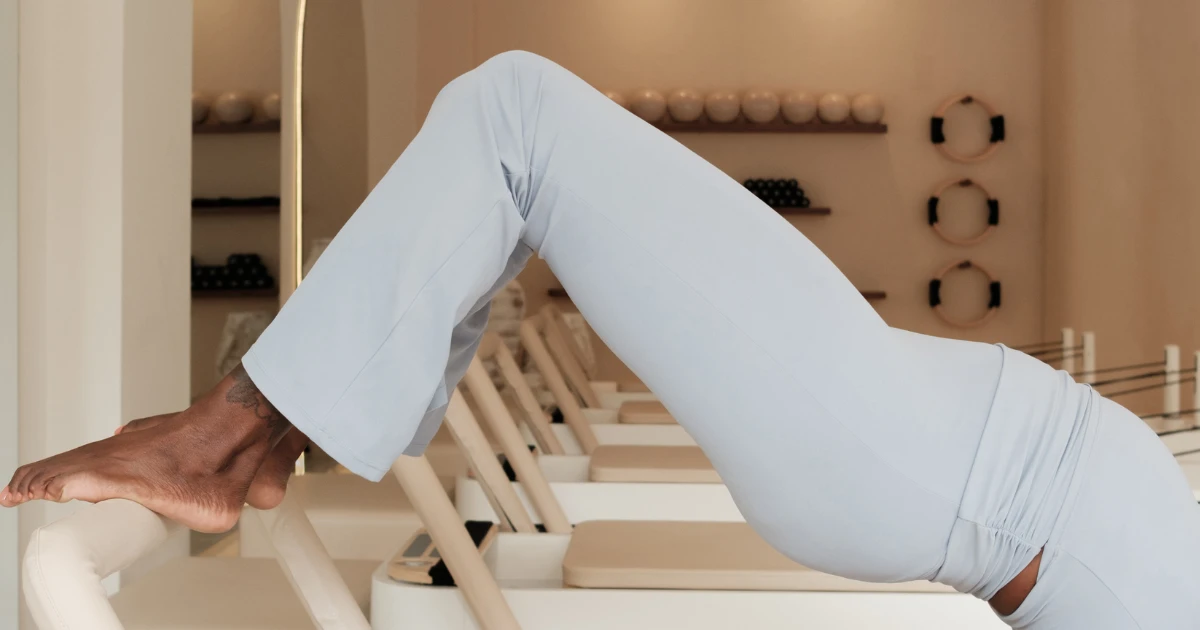
A Pilates Cadillac — also called a trapeze table, or full trapeze table to distinguish it from the smaller wall-mounted Tower — is a raised platform enclosed by a rectangular metal frame fitted with springs, bars, straps and an overhead trapeze bar. Unlike a reformer's sliding carriage, the Cadillac's platform stays still while you work against spring resistance lying, sitting, standing or suspended from the frame, which is why it shows up mostly in fully-equipped classical studios and clinical or private sessions rather than a typical group reformer class.
If you've mastered the reformer and started browsing more advanced studio equipment, you've probably come across the Cadillac — a tall, cage-like frame that looks more like specialised rehab equipment than a typical workout machine.
It's actually one of the original pieces of apparatus Joseph Pilates designed, and it remains a serious tool in fully-equipped studios. Here's what it is, what it's used for, and how it compares to the reformer you already know.
What Is a Pilates Cadillac?
A Cadillac — also called a trapeze table — is a raised, cushioned platform enclosed by a rectangular metal frame. The frame carries springs of varying tension, a push-through bar, a roll-down bar, and an overhead trapeze with straps and handles, giving you far more attachment points than a reformer's single footbar and set of straps. That range of hardware lets you train lying down, sitting, standing or even hanging from the frame.
According to a widely repeated account, the concept traces back to Joseph Pilates' internment on the Isle of Man during the First World War, where he worked in a camp hospital and is said to have attached springs to hospital beds so bedridden patients could exercise without getting up — the precursor to both the Cadillac and the reformer. It's a compelling story, but historians note there's no direct documented proof of his hospital work specifically, so it's worth treating as a plausible tradition rather than a confirmed fact.
Cadillac, Trapeze Table or Full Trapeze Table? The Names Explained
The same apparatus goes by several names — they're not different machines, just different ways people refer to the one thing.
- Cadillac is the informal, historical name — generally said to date back to Joseph Pilates' original New York studio in the 1930s, when a Cadillac car represented the height of American luxury and engineering. Clients reportedly saw the feature-packed apparatus and joked it was "the new Cadillac." It's a widely repeated story rather than a documented fact, but the nickname stuck.
- Trapeze Table is the more formal, manufacturer's name — Balanced Body and Peak Pilates both use it in their equipment catalogues.
- Full trapeze table specifically distinguishes the complete apparatus from the smaller Tower (see the FAQ below for exactly what's different).
- "The trapeze" on its own is sometimes shorthand for the whole apparatus, and sometimes means just the overhead bar and straps — one specific attachment among several. Context usually makes it clear which is meant.
Cadillac vs Reformer: What’s Different
| Feature | Reformer | Cadillac / Trapeze Table |
|---|---|---|
| Movement | Sliding carriage on rails | Fixed platform — you move around and above it |
| Main resistance | Springs under the carriage | Springs attached at multiple points on the frame |
| Positions used | Mostly lying, sitting or kneeling on the carriage | Lying, sitting, standing and suspended work |
| Typical setting | Group classes and studios of all sizes | Fully-equipped classical studios, clinical or private sessions |
Both machines use adjustable spring resistance and share some exercise names, but the Cadillac's fixed platform and overhead frame make it better suited to suspension work, deep stretching and rehabilitation-style exercises that a moving reformer carriage can't easily replicate. If you're new to Pilates equipment generally, our reformer vs mat Pilates guide is a better starting point than the Cadillac.
Anatomy of the Machine: Key Components
Unlike a reformer, where movement happens on a gliding carriage, the Cadillac's padded bed stays completely still — all the resistance and movement instead comes from hardware mounted on the surrounding frame.
- The padded table — a stable, raised platform that acts as your base for lying, sitting or kneeling work.
- The push-through bar — a hinged bar that can be sprung from above or below, used for shoulder and spinal extension work.
- The roll-down bar — a small bar suspended by two upper springs, used for controlled spinal articulation and mid-back strengthening.
- The trapeze bar and straps — overhead hanging attachments used for leg support, suspension work and more advanced acrobatic-style exercises.
- Multi-tension springs — a range of light, medium and heavy springs that hook on at different heights along the frame's posts.
The Science & Biomechanics of the Cadillac
What sets the Cadillac apart is how it lets an instructor manipulate gravity, alignment and the direction of resistance.
Spinal decompression and inversion
Suspending your legs, or hanging, from the overhead frame briefly takes body weight off the lower spine — a straightforward mechanical effect of unloading the joint. Whether that translates into meaningful pain relief is less settled: reviews of inversion-style decompression report mixed results overall, with a handful of small trials showing short-term improvement in sciatica pain when combined with ongoing physiotherapy, but no strong evidence it outperforms a sham treatment for general back pain, and no consensus yet on which patients actually benefit. Treat suspended Cadillac work as a supported stretch rather than a proven treatment, and leave the decision on whether it suits your injury to your physiotherapist.
Multi-directional resistance
On a reformer, resistance runs along one horizontal axis under the carriage. On a Cadillac, springs can be mounted high, low, wide or overhead, which lets an instructor or physiotherapist target a very specific line of pull — the rotator cuff or deep hip rotators, for example — in a way a reformer's fixed axis can't easily replicate.
A stationary base
Because the bed doesn't slide, the Cadillac removes the balance challenge of a moving carriage. That makes it more manageable for acute injury recovery, joint replacement rehabilitation or people with balance impairment, since you're not managing a shifting base of support on top of the exercise itself.
What You Can Do On It
- Push-through bar work — upper-body strengthening and stretching using the sprung horizontal bar, including the Tower Stretch, where you lie on your back with feet against the bar for a supported hamstring, calf and lower-back stretch.
- Trapeze and suspension work — hanging or supported exercises using the overhead bar and straps, including more advanced moves like the Hanging Back Bend, where your feet hook into overhead loops for a suspended backbend.
- Spring-assisted stretching — controlled, supported stretches that would be hard to hold unassisted, useful for improving flexibility safely.
- Roll-down bar work — spinal articulation exercises like Roll-Backs, where you sit holding the roll-down bar and articulate down spine-by-spine against spring assistance to train deep core control.
Who It Suits
Because the springs can fully support your body weight or add resistance in almost any position, the Cadillac genuinely suits two quite different groups:
- Rehabilitation and clinical patients — the fixed platform and supportive springs let injured, older or post-surgical clients move safely without the added challenge of a shifting carriage.
- Advanced athletes and dancers — the overhead frame supports suspended, acrobatic-style work that challenges upper-body pulling strength and extreme flexibility.
It's not inherently a beginner or advanced machine; it depends entirely on which exercises and spring settings your instructor sets up for you.
Will You Find One in a Regular Class?
Not usually. Cadillacs are large, stationary and expensive, and most SEQ studios build their group timetable around the reformer instead, since one instructor can safely run a room of moving carriages at once. The Cadillac is harder to supervise across a large group, particularly for hanging or high-tension work, so it tends to appear in fully-equipped classical Pilates studios, physiotherapy-led clinical sessions, or private and duet bookings rather than a standard drop-in class. If you specifically want to try one, it's worth calling ahead to check a studio has one and offers sessions that use it.
Is Cadillac Pilates harder than reformer Pilates?
Not inherently — difficulty comes down to the exercises and spring settings your instructor chooses, not the machine itself. Some Cadillac exercises, like supported stretches, are gentler than their reformer equivalents; others, like trapeze suspension work, are considerably more advanced.
Do beginners use the Cadillac?
Sometimes, particularly in a clinical or rehabilitation setting where a physiotherapist sets up fully spring-supported movements. In a general fitness context, most beginners start on a reformer or mat and move to the Cadillac later, once they're comfortable with core Pilates principles.
What’s the Difference Between a Cadillac (Full Trapeze Table) and a Tower?
A Tower — sometimes called a half trapeze — is essentially one end of a Cadillac: a single set of posts carrying leg springs, arm springs and a roll-down bar, usually mounted to a wall or the end of a reformer. A full Cadillac (full trapeze table) has posts at both ends of the frame, with the second end adding the push-through bar and the overhead trapeze itself — which is what gives you suspension and hanging work a Tower can't do. Most Tower exercises can also be done on a full Cadillac, but not the other way around.
Is “the Trapeze” the Same Thing as a Cadillac?
Usually, yes — "the trapeze" is common shorthand for the whole Cadillac apparatus. Occasionally it's used more narrowly for just the overhead trapeze bar and straps hanging from the frame, one specific attachment among several on the machine, so it's worth checking which sense is meant if it's not obvious from context.
Do I need a doctor’s referral to use the Cadillac?
Not for a private session at a boutique studio — no referral is required. But if you're managing an active spinal, hip or shoulder injury, it's worth seeing a physiotherapist or accredited exercise physiologist who uses the Cadillac as part of a Clinical Pilates care plan, rather than booking a general session yourself.
Sources
- Balanced Body — Pilates Cadillac / Trapeze Table
- Complete Pilates — What Is a Pilates Cadillac and What Are the Benefits?
- Online Pilates Classes — Tower with Push Thru Bar
- Physical Therapy in Sport — Is Pilates an Effective Rehabilitation Tool? A Systematic Review
- Yamato et al. — Pilates for Low Back Pain (Cochrane systematic review)