Guide
Reformer Pilates for Seniors: Benefits, Safety and What to Expect
Updated 25 July 2026
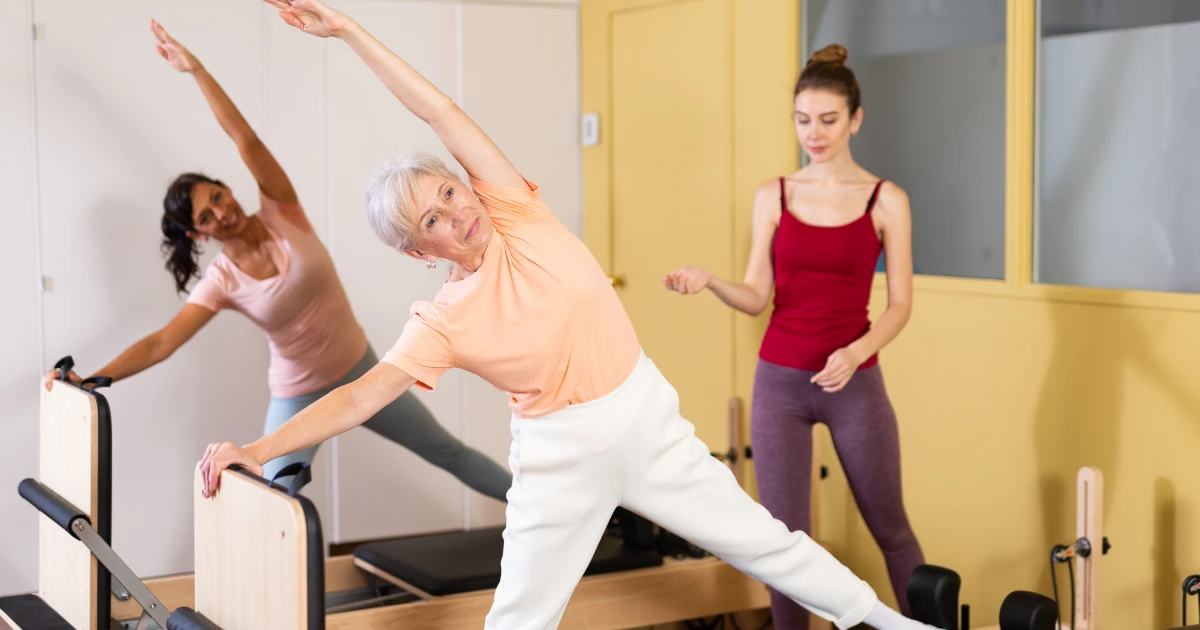
Reformer Pilates suits older adults well because spring resistance can be wound down to a very light, fully adjustable load, and the machine’s carriage and straps offer support a floor-based workout can’t. Research links Pilates to a large reduction in fall risk and improvements in balance, strength and functionality in older adults, though anyone with osteoporosis, a joint replacement or an active condition should look for a studio experienced in modifying classes accordingly, or start with Clinical Pilates instead.
As we age, maintaining functional strength, joint mobility and dynamic balance becomes essential for long-term independence. Traditional gym workouts or high-impact cardio can feel intimidating or hard on ageing joints, and reformer Pilates offers an adaptable, low-impact alternative built to develop physical resilience safely.
Whether you're looking to recover from an injury, manage joint stiffness or lower your risk of falls, here's what older adults should know before stepping onto the carriage.
Why the Reformer Suits Older Bodies
A reformer is a sliding carriage framed by springs, ropes and a footbar. For older adults specifically, it offers some real mechanical advantages over floor-based workouts or free weights.
Spring-based progressive resistance
Unlike dumbbells or a weight stack, which apply a constant gravitational load, a reformer's steel springs can be wound down to an ultra-light setting, letting you load muscles gradually through controlled eccentric and concentric movement without overloading a delicate joint.
Guided structural support
Balance or leg-strengthening work on a floor mat can feel unstable. A reformer's elevated carriage, padded headrest and adjustable footbar give you stable touchpoints, so you can work against resistance lying down, seated or supported — reducing the risk of an accidental trip or fall during the exercise itself.
| Consideration | Mat Pilates | Reformer Pilates |
|---|---|---|
| Getting into position | Requires getting up and down off the floor | Elevated carriage makes transfers easier |
| Resistance | Body weight only, fixed load | Adjustable spring tension, can start very light |
| Joint loading | Higher — more weight-bearing through joints | Lower — carriage and springs share the load |
Proven Benefits: What Reformer Pilates Helps With
Regular, appropriately modified practice is linked to measurable improvements across several functional areas.
Fall prevention and dynamic balance
A 2021 systematic review and meta-analysis in Physiotherapy, covering 39 studies and around 1,650 older adults, found Pilates produced a large effect on fall risk and moderate improvements in balance, strength, flexibility and general functionality compared with control groups. Strengthened ankle stabilisers and deep core muscles make everyday movements — stepping off a kerb, walking on uneven ground — noticeably more secure. A related 2021 systematic review in Frontiers in Medicine found similar improvements specifically in postural balance and reduced fear of falling among healthy older adults.
Functional everyday mobility
Reformer exercises tend to mirror everyday functional tasks. Footwork against the footbar strengthens the quadriceps and glutes you rely on to rise comfortably from a low chair or climb stairs without knee pain.
Postural realignment and spinal extension
Targeted back-extension exercises can help counteract the forward-slumping posture (kyphosis) that comes from prolonged sitting or osteoporotic changes in the spine, easing tension across the neck, shoulders and lower back.
Is Reformer Pilates Safe for Osteoporosis or Joint Replacements?
In most cases, yes — provided the right modifications are made.
Osteoporosis and osteopenia
Bone responds to mechanical stress, and standing, spring-resisted exercise is thought to stimulate bone-building cell activity, which may help slow density loss in the hips and spine — a 2022 systematic review in the Manual Therapy, Posturology & Rehabilitation Journal linked Pilates to pain relief, improved functionality and better quality of life in women with osteoporosis, alongside bone density benefits in some of the studies reviewed.
Key modification: if you have low bone density, deep forward spinal flexion — rolling up, abdominal crunches, rounded-spine twists — places compressive stress on fragile vertebrae and is generally avoided. Instructors typically favour flat-back, neutral-spine and gentle extension work instead.
Hip or knee replacements
Reformer footwork is a genuinely useful non-impact way to rebuild quad, hamstring and glute strength after joint surgery. The standard early-recovery precautions after a posterior-approach hip replacement are avoiding hip flexion past roughly 90 degrees and avoiding internal rotation — but precautions vary by surgical approach and surgeon, so always follow your own surgeon's or physiotherapist's specific restrictions rather than a general rule, particularly in the first three months.
If you're managing acute pain, active joint inflammation, or you're within three to six months of surgery, start with a physiotherapist-led Clinical Pilates program rather than a general class — clinical instructors tailor every exercise to your specific scans and medical restrictions.
What to Ask a Studio Before Booking
- "Do you offer seniors-specific or low-impact classes?" — these tend to move at a measured pace and avoid rapid transitions between standing, lying and kneeling.
- "What's your maximum class size?" — a small group (roughly four to eight people) means the instructor can supervise your alignment closely and offer individual modifications.
- "Are your instructors experienced with osteoporosis and joint-replacement modifications?" — confirm they're comfortable adjusting footbar height, spring tension and straps for your situation.
How Often Should Older Adults Attend?
| Frequency | Typical outcome |
|---|---|
| 1 session a week | Maintenance and gentle joint mobility |
| 2 sessions a week | A common target for balance, core strength and bone-loading benefit |
| 3+ sessions a week | More advanced conditioning and postural work, once adapted |
For most older adults, one to two sessions a week is a safe, sustainable starting baseline that gives connective tissue and muscle time to adapt without triggering undue fatigue or joint irritation — see our general guide on how often to do reformer Pilates for how that compares across age groups. As balance, strength and confidence improve, frequency can be adjusted to suit your goals.
Do I need to be flexible to start reformer Pilates?
Not at all. Improved joint mobility and flexibility are a result of practising Pilates, not a prerequisite — exercises are tailored to your current range of motion from the first session.
What should I wear to my first class?
Comfortable, stretchy clothing — leggings or track pants — that won't catch in the springs or rollers, plus grip socks, which most studios require for safety and hygiene on the equipment. See our full what to wear to reformer Pilates guide for more detail.
Will I be able to get on and off the reformer easily?
Generally yes — reformer carriages sit elevated off the ground (roughly knee height on most machines), which most people find noticeably easier than getting up and down from a mat on the floor.
Sources
- Fernández-Rodríguez et al., Physiotherapy — Pilates Improves Physical Performance and Decreases Risk of Falls in Older Adults: A Systematic Review and Meta-Analysis
- Moreno-Segura et al., Frontiers in Medicine — Pilates Reducing Falls Risk Factors in Healthy Older Adults: A Systematic Review and Meta-Analysis
- Rocha, Manual Therapy, Posturology & Rehabilitation Journal — Effect of the Pilates Method on People With Osteoporosis: A Systematic Review