Guide
Reformer Pilates for Beginners: What to Expect in Your First Class
Updated 31 August 2026
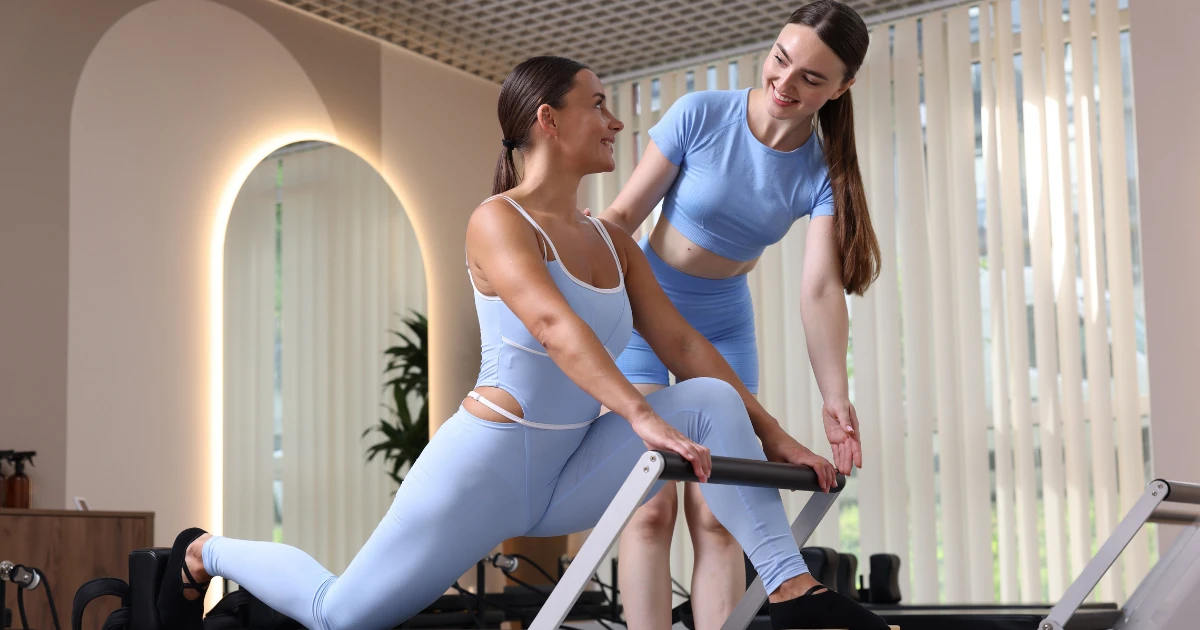
Your first reformer Pilates class starts with a short equipment orientation, then around 45 minutes of slow, controlled exercises with the springs set light so you can focus on form rather than resistance. Wear fitted activewear and grip socks, arrive 10–15 minutes early, and expect mild muscle soreness a day or two afterwards as the class activates stabilising muscles a regular workout usually misses.
Walking into a studio for your first reformer Pilates class can feel intimidating. The bed-like frame, hanging straps and metal springs look more like specialised equipment than a typical gym machine.
In reality, reformer Pilates is one of the most accessible, low-impact exercise formats around. Every movement is scaled by spring resistance to suit your current strength, flexibility and injury history, so a genuine beginner and someone training around an old injury can be in the same class.
This guide covers what to wear and pack, how the machine actually works, what a class looks like from start to finish, and what to expect in the days afterwards. If you'd rather start by comparing what's actually available near you, our suburb guides — like reformer Pilates in Milton, reformer Pilates in the CBD or reformer Pilates in Coorparoo — cover the local studios and formats on offer.
Before You Arrive: What to Wear & Pack
Preparing for a reformer class takes a little more thought than a throw-on-and-go gym session — see our full what to wear to reformer Pilates guide for more detail than the checklist below.
- Grip socks (required at almost every studio)
- Fitted activewear, without zippers or hardware
- A water bottle
- A hair tie if you have long hair
- Plan to arrive 10–15 minutes early
Wear grip socks
Grip socks — socks with a rubberised tread on the sole — are standard studio etiquette at almost every Pilates venue. They stop your feet slipping on the wooden standing platforms and metal footbar, and keep shared vinyl carriages hygienic. Most studios sell a pair at reception if you don't own any.
Choose fitted activewear over baggy clothes
Form-fitting leggings, bike shorts and fitted tops work best. Baggy shorts or a loose t-shirt can catch on the tracks, springs or pulleys as the carriage glides back and forth, and snug clothing lets your instructor actually see your alignment and spinal position to correct it.
Skip clothing with exposed back zippers, hardware or large plastic buttons — they can mark the vinyl upholstery and dig into your spine during exercises lying on your back.
Arrive 10–15 minutes early
Early arrival isn't just politeness — it's when your instructor runs your equipment safety orientation: how to lock the footbar, adjust spring loads, and step on and off a moving carriage safely. Turning up late usually means starting the class without it.
Anatomy of a Reformer: Decoding the Machine
Knowing the basic parts takes away most of the mystery before class starts:
- The carriage — the cushioned sliding platform you lie, sit, kneel or stand on.
- The springs — mounted under the carriage, they provide adjustable resistance that increases as the spring stretches, unlike a fixed gym weight.
- The footbar — an adjustable padded bar at the front of the frame you press against with your feet or hands.
- Straps & pulleys — ropes ending in handles or long loops, used for upper-body pulling work and leg-circle exercises.
- Shoulder blocks — two raised pads that stop you sliding up the carriage when lying down, and double as foot rests in plank-style exercises.
How spring colour coding works
Spring colour-to-tension mapping isn't standardised across manufacturers, so treat any colour chart as a guide to one specific machine rather than a universal rule. In general terms:
| Tension level | Typical feel | Common use |
|---|---|---|
| Heavy | Most resistance, most support | Footwork, and standing or kneeling exercises |
| Medium | Balanced resistance | Core stability and arm-pulling work |
| Light | Least resistance, least support | Abdominal series and balance challenges |
On Balanced Body reformers — the most common brand — yellow is the lightest spring and red sits in the middle; on other brands, like Peak Pilates, yellow marks a medium spring and blue a light one. Ask your instructor which colour means what on your studio's machine rather than assuming.
Counter-intuitive rule: heavier springs give you more support when standing or in a plank position, while lighter springs make the carriage less stable — which is exactly what forces your deep core stabilisers to work harder.
Class Flow: What Actually Happens in the Room
A standard beginner class runs 45 to 50 minutes and follows a fairly deliberate structure:
- Footwork & centring (about 10 minutes): lying on your back with your feet on the footbar, warming up the knees, hips and ankles while activating deep abdominal engagement.
- Abdominal & core series (about 15 minutes): curl-ups, tabletop positioning or short-box work targeting the deep abdominals and obliques.
- Straps & compound movement (about 15 minutes): feet in long straps for leg circles, or handles for shoulder, mid-back and triceps pulling patterns.
- Cool down & mobilisation (5–10 minutes): carriage-assisted stretches such as a seated side stretch or chest opener.
Common Beginner Movements You’ll Practise
- Footwork — pushing the carriage away using different foot placements (heels, arches, toes) to build leg alignment and core stability.
- The Hundred — lying on the carriage with head and shoulders lifted, pumping your arms rhythmically against light resistance while holding a stable core.
- Feet in straps (leg circles) — lying down with feet in long loops, moving your legs in smooth, controlled circles for hip mobility and lower-abdominal control.
- The Elephant — a standing hinge with hands on the footbar and feet on the carriage, using your abs to draw the carriage in while rounding the spine.
- Mermaid — a seated side stretch that opens the ribcage and restores lateral spinal mobility.
Post-Class Expectations: Soreness & Frequency
Mental fatigue vs muscle fatigue
In your first class, your brain often works as hard as your muscles. Coordinating breathing, carriage movement, neutral spine cues and spring changes takes real concentration, so feeling a bit clumsy or uncoordinated is completely normal.
Delayed onset muscle soreness (DOMS)
Expect mild, deep soreness 24 to 48 hours after your session. Reformer work tends to hit different muscles than weight training — think inner thighs, glute medius, deep abdominals and the muscles between your shoulder blades — because it activates smaller stabilising muscles rather than just the major groups.
How often should beginners go?
One to two classes a week is a reasonable starting point for building movement patterns and strength without excessive soreness. Three or more a week suits people who've already adapted to the movement mechanics and want more consistent conditioning — our guide on how often to do reformer Pilates covers this in more depth once you're past your first few classes.
Do I need to be flexible or fit to start?
No. Spring tension can be wound right down, or set up to fully support your body weight, so the machine adapts to you rather than the other way around. Most people start reformer Pilates specifically to build flexibility, core strength and mobility — not because they already have it.
What if I can’t keep up with the class?
Instructors expect a range of paces in any class and will encourage you to work at your own. If a spring feels too heavy or a joint feels stressed, it's completely normal to pause, let the carriage rest and ask for a modification.
Can I do reformer Pilates with lower back pain or a joint injury?
Often yes, but tell your instructor before the session starts. Reformers are widely used in clinical rehabilitation because the sliding carriage allows non-weight-bearing exercise that can strengthen the spine and joints without high impact — though if you have a specific diagnosis, it's worth checking with your physiotherapist or a Clinical Pilates provider first.
Sources
- Healthline — Reformer Pilates: What It Is, Benefits, Risks, Exercises, and More
- Better Health Channel — Pilates – Health Benefits
- Yamato et al. — Pilates for Low Back Pain (Cochrane systematic review)
Explore