Guide
What Is Barre? How It Compares to Pilates (And Which Is Right for You)
Updated 25 July 2026
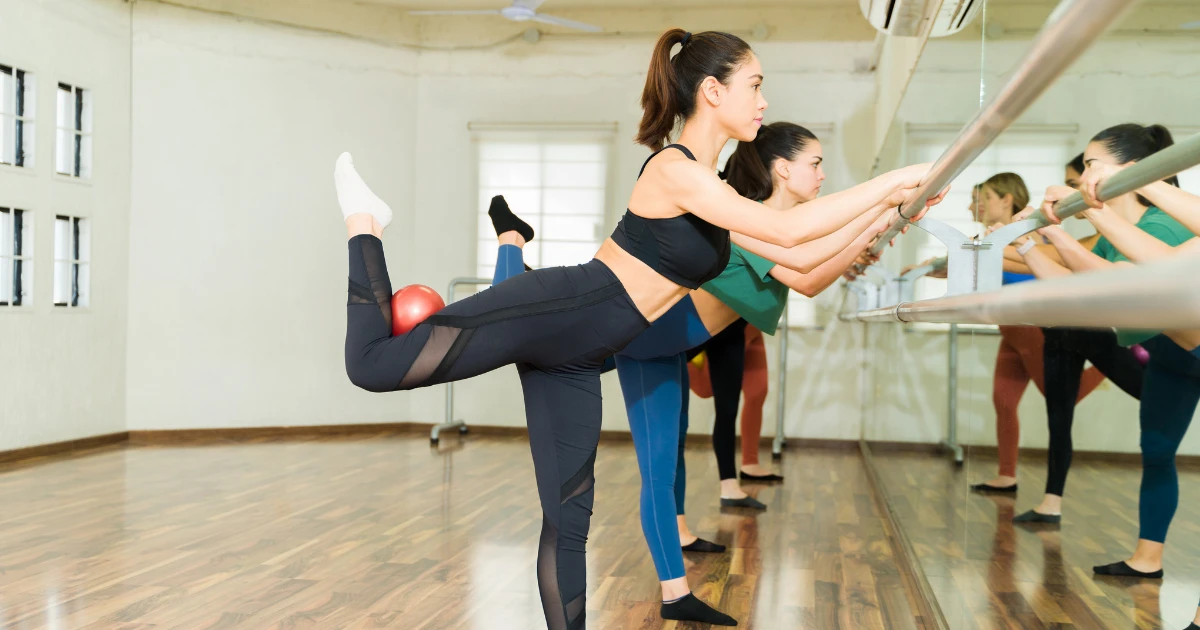
Barre is a low-impact fitness class built around isometric holds and small, high-repetition pulses at a ballet barre, blending ballet conditioning, Pilates-style core work and light resistance to build muscular endurance in the lower body. Pilates instead trains full-range, controlled contractions driven from a stable core, targeting the deep spinal stabilisers rather than burning out a muscle with repetition — the two build different qualities, and many people find doing both in the same week complements each other well.
If you're after a low-impact, muscle-toning workout, two names keep turning up on studio timetables: Barre and Pilates. Both focus on posture, flexibility and core strength without heavy lifting, but they get there through genuinely different training mechanics.
Whether you're weighing up a ballet barre class or a Pilates reformer session, here's how the two compare — origin, biomechanics, and how to choose between them.
At-a-Glance Comparison
| Feature | Barre | Pilates (Mat & Reformer) |
|---|---|---|
| Origin | Lotte Berk, London, 1959 — blending ballet and rehab | Joseph Pilates, 1920s — developed for full-body conditioning |
| Primary movement style | Isometric holds, small pulses, high repetition | Controlled, full-range contractions with breathwork |
| Primary focus | Muscular endurance — glutes, thighs, calves, arms | Deep spinal stabilisers, core control and posture |
| Equipment used | Ballet barre, light hand weights, bands, small balls | Mat, or a reformer's springs, pulleys and straps |
| Pace & environment | Upbeat, music-driven, higher-energy | Slower, deliberate, precision-focused |
You'll often see calorie-burn figures quoted for each format — barre is commonly estimated a little higher than Pilates per session, since the continuous pulsing keeps your heart rate more elevated. Treat any specific number with caution though: it swings enormously with your body weight, the instructor's pacing and how deeply you hold each position, and there's no well-controlled study pinning an exact figure to either format.
What Is Barre? Origin & Method
Barre traces back to Lotte Berk, a German-born dancer who fled Nazi persecution for England in 1938. After a back injury ended her performing career, she worked with an osteopath to develop a conditioning routine that combined her ballet training with rehabilitative exercise — protecting the spine while still building strength. She opened a studio in a London basement in 1959 teaching the method, and it later crossed the Atlantic when a student, Lydia Bach, opened the first US studio in Manhattan in 1971. Every modern barre franchise and independent studio traces back to that original blend.
- Ballet technique — positions like first position or a plié, used as fitness setup cues rather than formal dance training.
- Pilates-style core stability — core engagement runs through nearly every barre exercise.
- Light resistance — small hand weights or resistance bands add load to high-repetition work.
- Music-driven choreography — classes are typically upbeat and rhythmic rather than slow and deliberate.
Despite the ballet barre being central to the format, it's used purely as a hand-hold for balance while you perform small pulsing movements — often just an inch or two of range — to fatigue a target muscle group. No dance experience or existing flexibility is required.
The Science: Isometric Holds vs Full-Range Movement
The biomechanics explain why these two formats feel so different in practice.
Isometric holds and time under tension (Barre)
Barre relies heavily on isometric contractions — holding a muscle under tension without changing its length, like holding a plié — then adding small pulses and high repetitions to work the muscle towards local fatigue. This style is well-supported for building lower-body muscular endurance and postural support; the American Council on Exercise's own overview of barre training highlights it as an effective, low-injury-risk format for total-body strengthening and postural alignment.
Deep stabilisers and full range of motion (Pilates)
Pilates instead prioritises controlled contractions through a full range of movement rather than isolating one muscle to exhaustion. It trains movement integration, activating the deep stabilising muscles — the transversus abdominis, multifidus and pelvic floor — that barre's shorter-range pulses engage less directly. A 2024 systematic review in BMC Sports Science, Medicine and Rehabilitation found consistent evidence that Pilates improves posture and spinal alignment across a range of populations.
Barre vs Pilates: Key Differences
Core engagement
Pilates: core control is the central driver of every movement — you initiate each exercise from the centre out.
Barre: core strength supports your alignment throughout, but the primary target is usually lower-body endurance and shoulder definition.
Muscle fatigue vs mechanical load
Barre: uses light resistance — small hand weights, bands, body weight — with the challenge coming from high repetitions and time under tension.
Reformer Pilates: uses adjustable spring tension to change the mechanical load directly, building full-body strength across a longer range of motion.
Class tempo
Barre: upbeat and fast-paced, synced to music, with continuous pulsing keeping your heart rate elevated throughout.
Pilates: slower and precision-driven, with a strong focus on breathing pattern, spinal alignment and movement quality over pace.
Which Should You Choose?
Choose barre if you:
- Love an upbeat, music-driven group class
- Enjoy the muscle burn of isometric holds and high-rep conditioning
- Want to target lower-body endurance — glutes, thighs, calves — and balance
Choose Pilates if you:
- Are managing low back pain, joint stiffness or recovering from an injury
- Want a heavier focus on deep core stability and postural alignment
- Prefer a methodical, controlled pace over a faster-paced, cardio-leaning class
Because they train different qualities — endurance versus stability — doing barre and Pilates in the same week, rather than picking one permanently, builds a genuinely well-rounded routine.
If you're comparing formats more broadly, our Pilates vs yoga guide covers how yoga fits into the same picture.
Do I need ballet experience for barre?
No. Barre uses ballet terms — like first position or plié — as simple setup cues for a fitness movement, not as formal dance technique. No background in dance is required.
Is barre as effective as reformer Pilates for core strength?
Both strengthen your core, but they target it differently. Pilates specifically trains the deeper stabilising layers of the spine and abdominal wall through controlled, full-range movement; barre leans more on superficial muscular endurance and postural support built up through standing, high-repetition work.
Can I do barre if I’m not very flexible?
Yes. Barre improves mobility over time through active stretching and light isometric holds built into the class, so it suits a wide range of starting flexibility levels rather than requiring it upfront.
Sources
- Wikipedia — Lotte Berk
- American Council on Exercise — Hitting the Barre: Understanding the Popular Group Fitness Trend
- BMC Sports Science, Medicine and Rehabilitation — Effects of Pilates Exercises on Spine Deformities and Posture: A Systematic Review
- Yamato et al. — Pilates for Low Back Pain (Cochrane systematic review)